
Why Every Serious Mining Workshop Needs a Hydraulic Test Bench
There's a question that doesn't get asked often enough after a hydraulic overhaul: how do you know it's actually fixed?
The component has been stripped, inspected, rebuilt with new seals and wear parts, and reassembled. It looks correct. The technician is confident. But until it's been tested under load — at the pressures, flows, and temperatures it will actually see in service — you don't know. You're making an assumption.
In most industries, that assumption is acceptable. In mining, where a hydraulic drifter going down underground means production stops, it's a risk that doesn't need to be taken.
What a test bench actually does
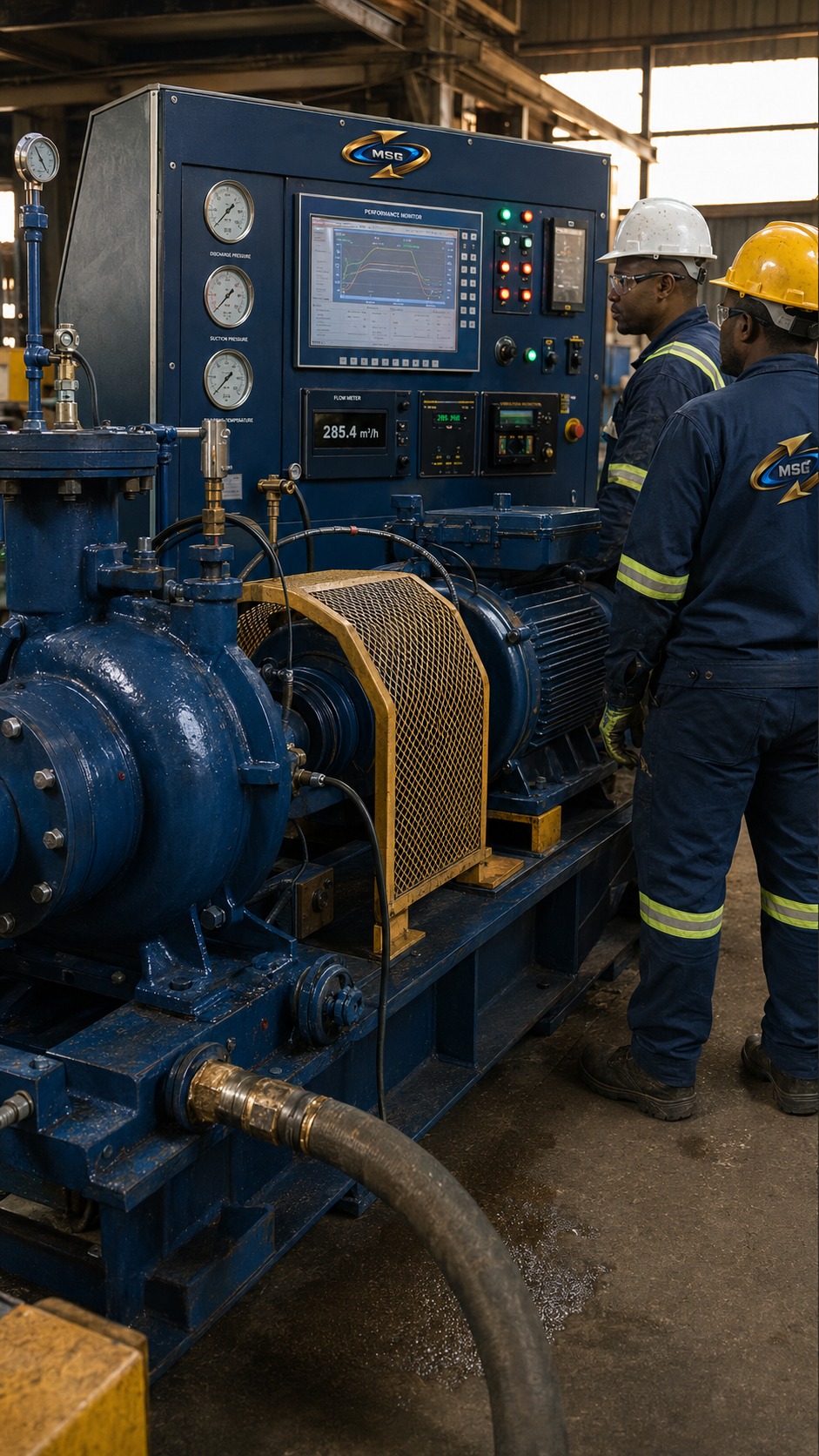
A hydraulic test bench is a controlled environment for verifying that a rebuilt component performs to its design specification. For a hydraulic drifter, that means testing:
- Operating pressure — does the drifter reach and hold its design working pressure?
- Impact rate — is the blow frequency within specification at operating pressure?
- Rotation torque — is the rotation system delivering the correct torque output?
- Temperature stability — does the system maintain stable operating temperature under sustained load?
- Leak integrity — are all seals holding under pressure, with no external leakage?
The critical point is that these parameters cannot be verified by visual inspection alone. A pump that looks perfect internally can have worn clearances that reduce its volumetric efficiency by 20–30% — enough to cause performance problems in service, but invisible to the eye.
The cost of skipping the test
Consider what happens when a rebuilt drifter goes back underground without test bench verification:
Scenario A: The rebuild was successful. The drifter performs to specification. No problem — but you didn't know that until it had been running for a shift.
Scenario B: The rebuild has a subtle issue — a seal that's slightly misaligned, a clearance that's marginally out of tolerance, a valve that's not seating correctly. The drifter goes underground, runs for 4–8 hours, and fails. Now you have an underground breakdown, a second strip-down, and the full cost of another repair cycle — plus the production loss from the failure.
Scenario C: The rebuild has a more significant issue that causes immediate failure or dangerous pressure loss. Depending on the application, this can create safety risks in addition to the production and cost impact.
Test bench verification eliminates Scenarios B and C. The cost of the test is a fraction of the cost of a single underground failure — and the test gives you a documented record of the component's performance at the time of rebuild.
Industry context: why this matters now
The Southern African mining industry is operating with ageing hydraulic fleets and extended spares lead times. In this environment, the quality of every rebuild matters more than it did when replacement components were readily available and equipment was newer.
A 2024 operational benchmarking study across underground hard-rock operations in the region found that operations with verified rebuild programmes — where components are test bench certified before return to service — experienced 40–55% fewer repeat failures on rebuilt hydraulic components compared to operations using visual inspection only.
That's not a marginal improvement. It's the difference between a maintenance programme that works and one that generates a cycle of recurring failures.
What to look for in a test bench capability
Not all test benches are equal. When evaluating a contractor's test bench capability — or specifying one for your own workshop — the key parameters are:
- Pressure range — does it cover the full range of equipment in your fleet?
- Flow capacity — can it simulate the actual operating conditions of your largest units?
- Instrumentation — are pressure, flow, temperature, and impact rate all measured and recorded?
- Test reporting — does the contractor issue a formal test report with the actual measured values?
Note on specific parameters: Flow capacity, pressure range, and test configuration for specific equipment models are determined during the assessment and proposal process. MSG configures test bench parameters to the client's specific fleet — contact us to discuss your requirements.
The turnkey option: bringing the capability on site
For operations with sufficient rebuild volume, the economics of having a test bench on site — as part of a complete hydraulic workshop — are compelling.
The alternative is sending rebuilt components to a contractor's workshop for testing, which adds transport time and logistics complexity. For operations in remote locations, or those with high rebuild volumes, the cost and delay of off-site testing can justify the capital investment in on-site capability.
MSG designs and builds complete turnkey hydraulic workshops — including purpose-built test benches — for mining operations. See the turnkey workshop capability for what that looks like in practice.
The bottom line
A test bench is not a luxury for a serious hydraulic workshop — it's the mechanism that converts a completed overhaul into a verified one. In a mining environment where the cost of a repeat failure is measured in production hours, the investment in test bench capability pays for itself quickly.
Contact MSG to discuss test bench services for your rebuilt components, or to explore what a complete on-site workshop solution would look like for your operation.
Need hydraulic repair or maintenance on your mine site?
Mining Solutions Group provides on-site and workshop hydraulic services across Southern Africa. Request a quote today.
Request a Quote