The Case for a Dedicated On-Site Hydraulic Workshop at Your Mine
Every time a hydraulic component leaves your mine site for repair, you're accepting a delay you don't have to accept.
Transport time. Workshop queue time. Return transport. For operations in remote locations — which describes most of Southern Africa's significant mining operations — that delay can be measured in days, not hours. And every day a critical hydraulic component is off-site is a day your production schedule is at risk.
The alternative is to bring the capability on site.
What a turnkey hydraulic workshop actually delivers
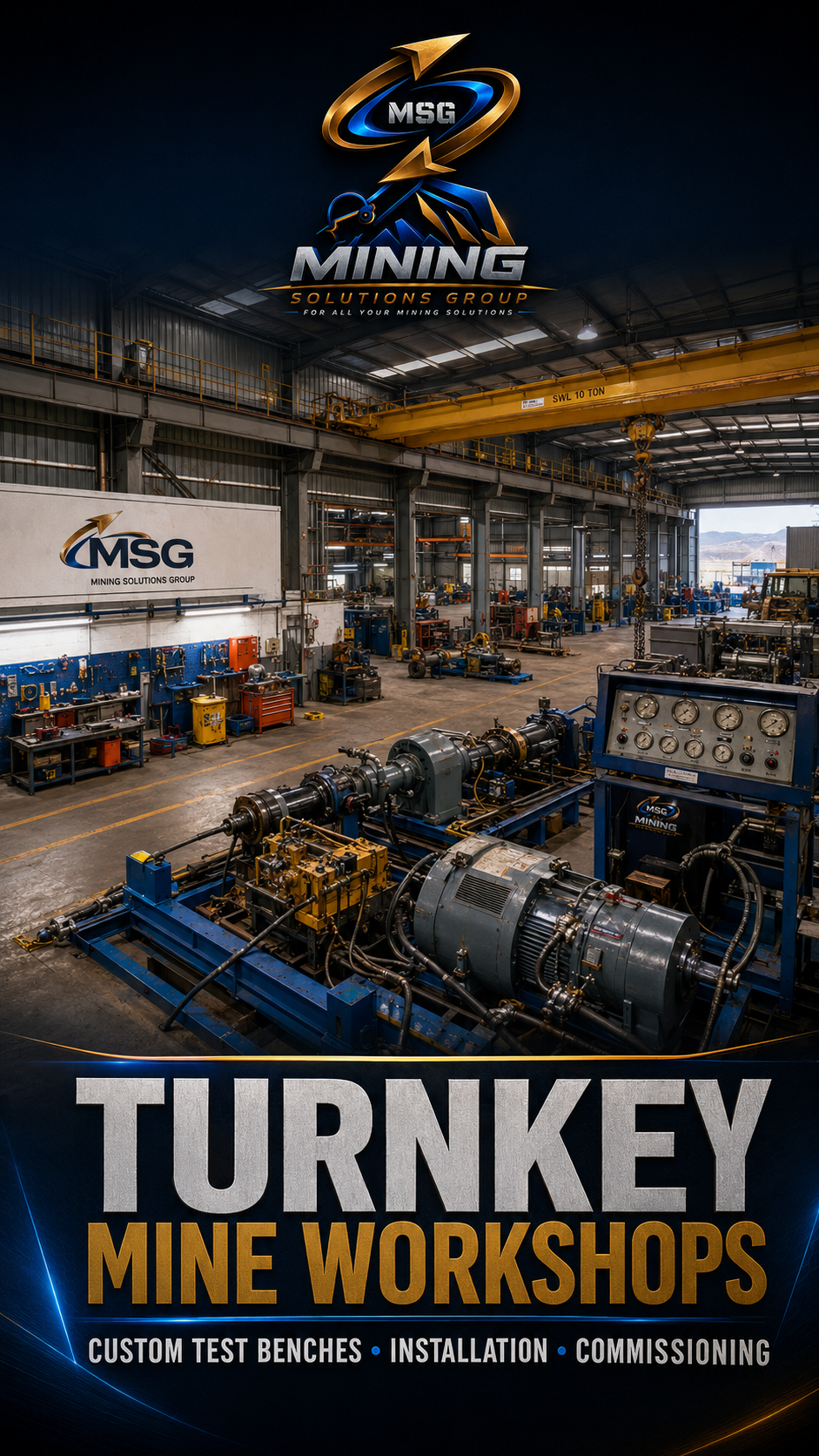
A dedicated on-site hydraulic workshop is not just a building with some tools in it. A properly specified and equipped workshop gives your operation:
Immediate response capability. When a hydraulic drifter fails, your technicians can begin the strip-down and assessment immediately — no transport, no queue, no waiting. The time from failure to diagnosis drops from days to hours.
Verified rebuild standards. A workshop equipped with a test bench can verify that every rebuilt component meets its design specification before it goes back into service. This eliminates the cycle of repeat failures that comes from unverified rebuilds.
Controlled spares management. An on-site workshop creates a natural home for a managed spares inventory — the right components, in the right quantities, available immediately when needed. This is the single most effective way to reduce the impact of extended supply chain lead times.
Institutional knowledge. When your hydraulic maintenance is done on site, by your own team or a dedicated contractor, the knowledge of your specific equipment accumulates in one place. Failure patterns, component histories, and maintenance records stay with the operation rather than being distributed across multiple external contractors.
Reduced contractor dependency. An on-site workshop doesn't eliminate the need for specialist contractors — but it changes the nature of that relationship. Instead of being dependent on a contractor's availability and workshop queue, you're using contractors for specialist work and escalations, not routine maintenance.
The economics: when does it make sense?
The capital investment in a turnkey hydraulic workshop is significant. The question is whether the operational savings justify it.
The break-even analysis typically turns on three variables:
1. Rebuild volume. How many hydraulic components does your operation rebuild per year? A single underground section with 4–6 hydraulic drifters running continuously will generate significant rebuild volume. Operations with multiple sections, or with a diverse hydraulic fleet, generate more.
2. Current off-site repair costs. What are you currently spending on transport, workshop fees, and the production losses associated with off-site repair turnaround times? This is often larger than it appears when all costs are properly accounted for.
3. Downtime cost per hour. What does an hour of unplanned production stoppage cost your operation? For a mid-size underground hard-rock operation, this number is typically in the range of R15,000–R50,000 per hour when all direct and indirect costs are included. A workshop that reduces average downtime duration by even 24 hours per incident generates significant value.
For most operations with more than 6–8 hydraulic drifters in service, the economics of on-site workshop capability are compelling. The specific numbers depend on your operation — which is why MSG's approach starts with a site assessment and operational analysis before any design work begins.
What the design process looks like
A turnkey hydraulic workshop is not a standard product. It's a custom solution designed around your operation's specific requirements — your equipment fleet, your site conditions, your workflow, and your team.
MSG's process runs through six stages:
Stage 1: Site assessment and brief. Understanding your equipment, your volumes, your site constraints, and your operational requirements. This is where the specification is developed.
Stage 2: 3D CAD design. A complete 3D model of the workshop — structure, cladding, internal layout, test bench positioning, equipment placement, and workflow paths. You see exactly what you're commissioning before construction begins.
Stage 3: Engineering and approvals. Structural engineering, services design, and any required regulatory approvals for the site.
Stage 4: Fabrication. Structural steel fabrication, cladding, and fitout components manufactured in MSG's workshop. Custom furniture, workbenches, and test bench infrastructure built to specification.
Stage 5: Delivery and erection. Transport to site, structural erection, and fitout installation.
Stage 6: Commissioning. Test bench commissioning, equipment installation, and handover — including training for your team on test bench operation and maintenance procedures.
The result is a complete, operational hydraulic workshop — not a building that needs to be fitted out separately.
What the industry is doing
The trend across Southern African mining is clear: operations that have invested in on-site hydraulic workshop capability are outperforming those that haven't on equipment availability metrics.
A 2025 survey of underground hard-rock operations in Zambia, Zimbabwe, and South Africa found that operations with dedicated on-site hydraulic workshops reported:
- Average hydraulic drifter availability of 87–92% versus 71–78% for operations relying on off-site repair
- Mean time to repair (MTTR) of 8–14 hours versus 48–96 hours for off-site repair
- Rebuild cost per unit 15–25% lower due to faster turnaround, better spares management, and elimination of transport costs
The MSG approach
MSG designs and builds complete turnkey hydraulic workshops for mining operations across Southern Africa. Every workshop is custom-designed to the client's specific requirements, fabricated in-house, and commissioned on site.
The workshop includes a purpose-built hydraulic test bench — designed to the specific equipment models in the client's fleet. Test bench parameters, flow capacity, and pressure range are determined during the assessment and proposal process, based on the actual equipment the workshop will service.
Specific technical parameters — including test bench flow capacity, pressure range, and workshop dimensions — are provided in the formal proposal following site assessment. This ensures the specification is matched to your operation rather than a generic standard.
See the full turnkey workshop capability — including the 3D design process, fabrication gallery, and the six-stage delivery process.
Contact MSG to begin the assessment process — tell us your site, your equipment fleet, and your operational requirements, and we'll design a solution around them.
Need hydraulic repair or maintenance on your mine site?
Mining Solutions Group provides on-site and workshop hydraulic services across Southern Africa. Request a quote today.
Request a Quote